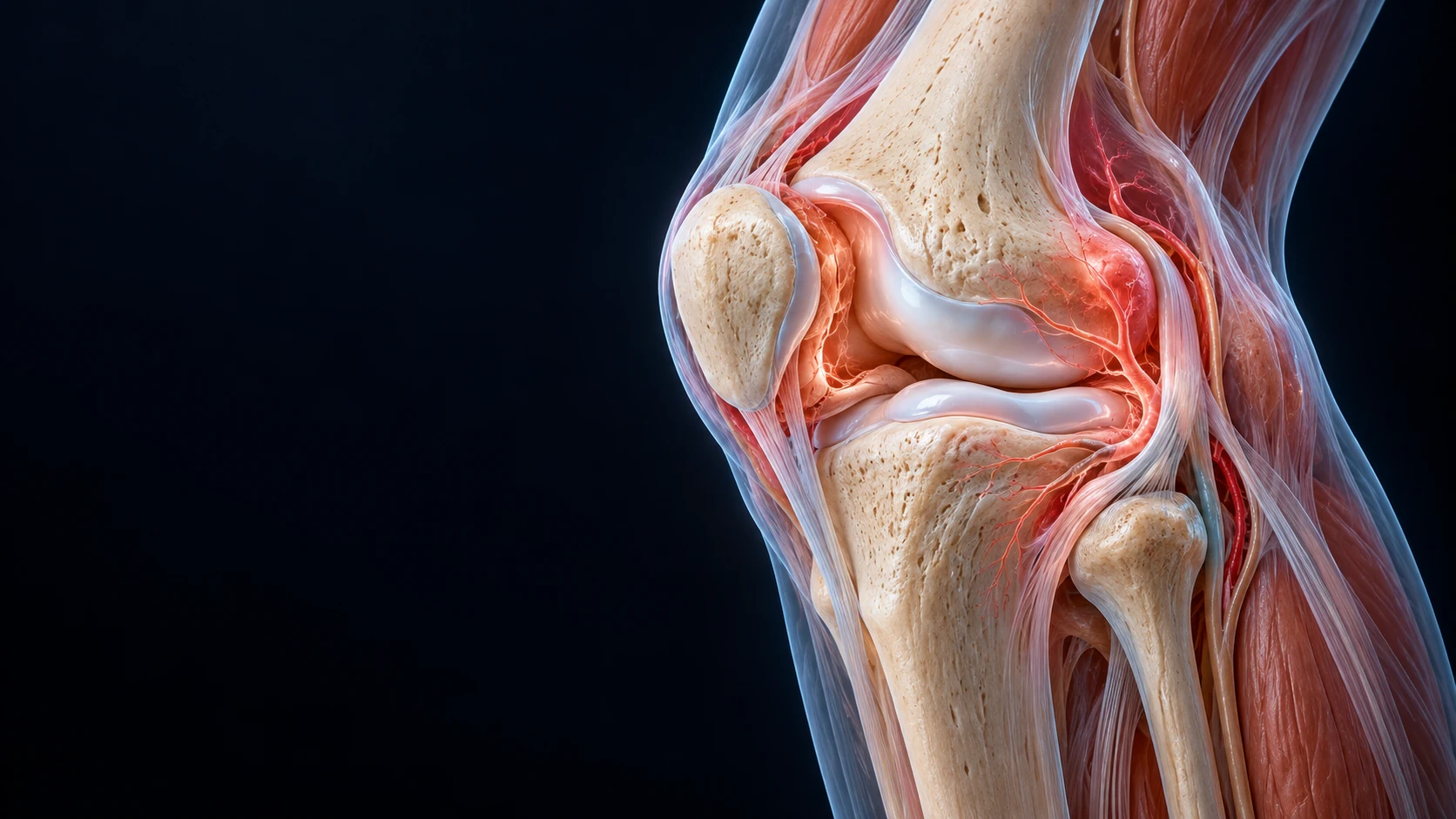
When usual care
hasn't been enough.
If osteoarthritis pain continues despite treatments such as exercise, physical therapy, weight management, medicines or injections, ask whether KneeSeal could be an option.

KNEESEAL · TARGETED KNEE PAIN TREATMENT
KneeSeal is genicular artery embolization (GAE)—a same-day option for knee pain relief in suitable patients.
Dr. Brian Ballard, DO, RPVIInterventional CardiologistNational board certifications across multiple specialties · Port Huron, Michigan
Estimated clinical success
at 3 years.
Results were estimated for each treated knee, with no comparison group. Thirteen knees were treated again. Results vary.
Understand the resultsWHAT THE RESEARCH SHOWS
In a 2026 randomized study, adding the procedure to standard care led to greater average pain improvement at one year.
See the research behind KneeSealAverage pain-score reduction
with the procedure + standard care at 1 year
50 participants. Patients knew which treatment they received; there was no simulated-procedure group. These percentages show average pain-score reductions, not how many people became pain-free.
HOW KNEESEAL WORKS
A promising advance in nonsurgical knee pain relief, with results that can last.
Osteoarthritis can cause pain in several ways. Along with changes in cartilage and bone, the lining of your knee joint can become inflamed and develop an abnormal network of tiny blood vessels.
Using imaging to guide the treatment, your doctor reduces blood flow to selected abnormal vessels. The aim is to ease inflammation and pain while protecting normal circulation.
KneeSeal targets selected small blood vessels, not the joint surfaces. It does not regrow cartilage, reverse arthritis, or guarantee relief.
THE KNEESEAL FILM
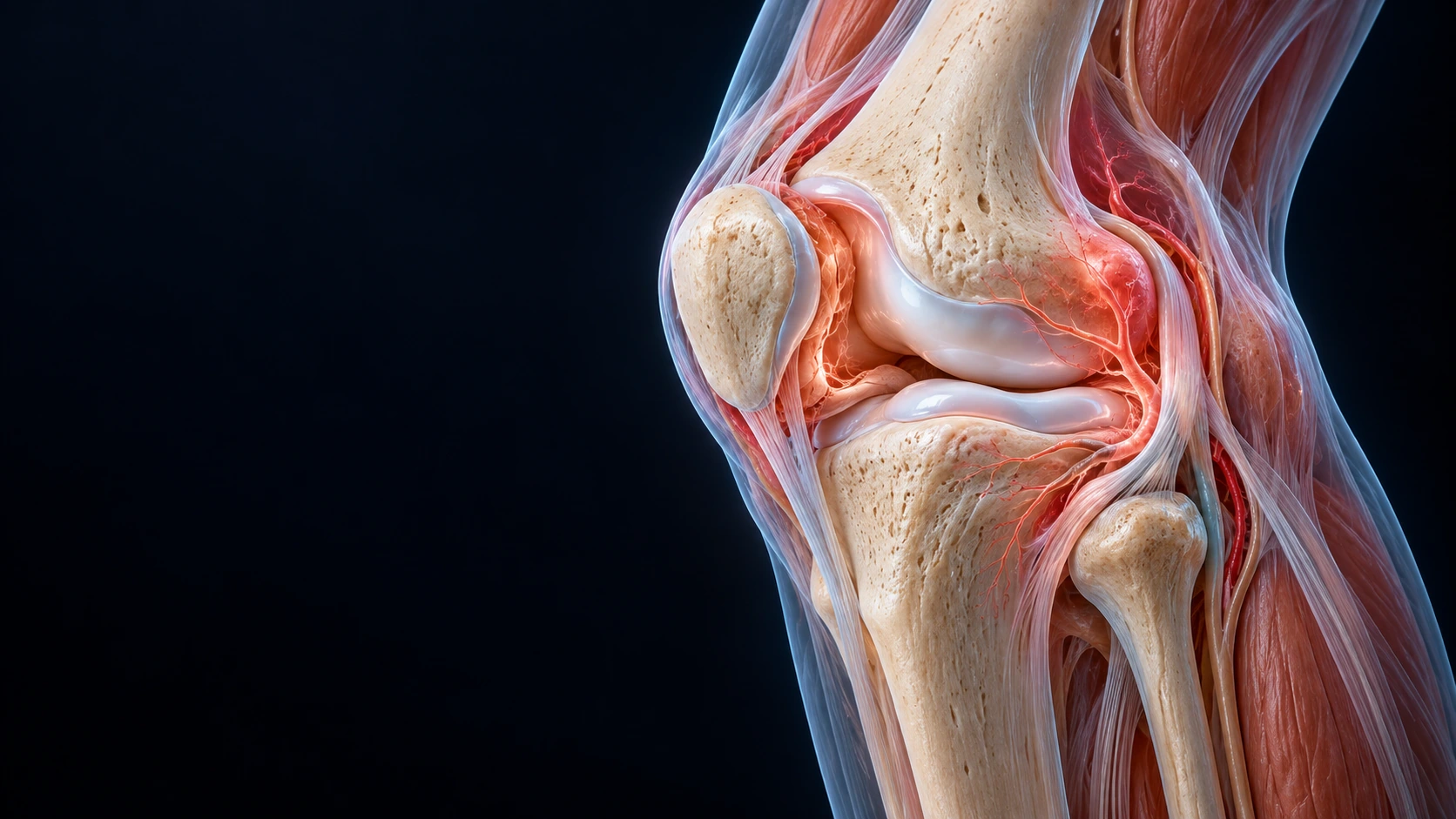
This animation shows the small blood vessels linked to an inflamed knee lining and how KneeSeal aims to reduce pain.
 INSIDE YOUR KNEE
When the lining of your knee becomes inflamed, an abnormal network of tiny blood vessels can develop and contribute to pain.
KneeSeal targets the vessels feeding inflammation.The final scene illustrates the hoped-for result. It does not show an actual patient's before-and-after results. Everyone responds differently.
This animation is a simplified illustration. It does not show a real patient or exact anatomy, sizes or timing. The pain effects are visual cues, not measured results. An inflamed joint lining and abnormal vessel growth can contribute to knee pain, but other causes matter too. Treatment aims to protect healthy circulation, although particles can unintentionally block vessels supplying healthy tissue. KneeSeal does not rebuild cartilage, reverse arthritis or guarantee relief. Scientific background.
COULD KNEESEAL HELP YOU?
If knee pain still gets in the way after physical therapy, medicines or injections, it may be worth talking about KneeSeal. First, we need to understand what's causing your pain and whether this treatment is right for you.
If osteoarthritis pain continues despite treatments such as exercise, physical therapy, weight management, medicines or injections, ask whether KneeSeal could be an option.
KneeSeal may be an option if you hope to delay knee replacement, are not ready for it, or cannot have surgery. Knee replacement generally remains possible afterward, though research on surgery after KneeSeal is limited. Talk with your surgeon about timing.
Researchers are studying KneeSeal for pain after knee replacement, but the evidence is more limited than for osteoarthritis. Your orthopedic team must first check for infection, a loose or unstable implant, and other mechanical problems.
Your doctor will consider your circulation, kidney function, bleeding risk, any infection or contrast allergy, and whether you are pregnant. These factors, along with the cause of your pain, help determine whether KneeSeal is appropriate. A consultation is a chance to explore your options; it does not commit you to a procedure.

MORE THAN A PAIN SCORE
The longer walk. The familiar trail. The day that feels like yours again.
LOOKING AT THE EVIDENCE
The goal is less pain and easier movement. These studies looked at the embolization procedure that we call KneeSeal. They did not test a separate KneeSeal-branded treatment protocol.
In a 50-person study, patients receiving the procedure plus standard care had greater average knee-pain improvement at one year than those receiving standard care alone.
Read the 2026 studyAVERAGE PAIN-SCORE REDUCTION AT 1 YEAR
These percentages show improvement in pain scores, not how many people became pain-free. Patients knew which treatment they received, and there was no simulated-procedure group for comparison.
72 PATIENTS · 95 KNEES
79.8% estimated cumulative clinical success at 3 years
Researchers followed 72 patients with 95 treated knees and estimated how often pain relief lasted, counting each knee separately. Thirteen knees received a second embolization.
There was no comparison group. This estimate does not tell us your personal chance of success or guarantee three years of relief.
Explore the long-term study40-PERSON PROSPECTIVE STUDY
At least 50% symptom improvement in 18 of 38 patients (47%) at two years
The WOMAC arthritis score measures pain, stiffness and physical function. This result counts people who reached a substantial-improvement threshold; it does not count everyone who experienced any relief. Forty people enrolled in this study, which had no comparison group.
Of the 25 patients who had improved at one year and were available for follow-up, 18 (72%) still met the study's goal at two years. There was no comparison group, and patients whose treatment had failed earlier were counted as failures at two years. Not everyone benefits or becomes pain-free.
Explore the two-year studyWhat this means for you: There are reasons to be hopeful, but also important uncertainties. Studies comparing this procedure with a simulated treatment have not consistently found extra benefit. Research is ongoing. The studies above measured different things, so their percentages cannot be compared directly. Dr. Ballard can help you understand what the evidence may mean for your knee. Controlled-trial context.
Could this be your next step?
Talk with Dr. Ballard's teamRisks include bleeding or bruising where the catheter enters, infection, a reaction to contrast dye, kidney injury and radiation exposure. Skin discoloration or injury, damage to a blood vessel or nerve, temporary numbness, and a temporary increase in pain can also occur. Particles may unintentionally block vessels supplying healthy tissue, which can damage skin, muscle or bone. Serious complications are rare but possible.
Ask your doctor about the likely benefits, uncertainties and other options. Depending on your knee and overall health, physical therapy, exercise, weight management, medication, injections, treatments that target nerves, or surgery may be a better choice.
The materials used to block these vessels may be used “off-label,” meaning this knee-pain use is outside their FDA labeling. Ask which material your doctor plans to use and what that means for you. An FDA Breakthrough designation does not mean a device is approved for this use.
Read the supporting researchYOUR DAY AT MCLAREN PORT HURON
Here's what a typical treatment day with Dr. Ballard looks like. Your care team will adjust the plan for your health, medicines and individual needs.
Dr. Ballard typically begins with a small needle puncture in the dorsalis pedis artery on top of the foot near the ankle. A small 4F sheath allows a fine wire and a short 4F RIM catheter to travel inside the blood vessels toward the knee. This avoids open surgery. Depending on your blood vessel anatomy, he may use an artery in the groin instead.
Simplified illustration, not a treatment plan. Devices and vessels are enlarged for clarity. The catheter stays inside blood vessels; it does not enter the knee joint. Your doctor will discuss the access route, risks and recovery with you.
You'll discuss your symptoms, previous treatments and knee imaging. Your team will also review your medicines, allergies, kidney function and circulation, then explain when to stop eating and drinking and how to take your medicines.
Numbing medicine and light sedation help keep you comfortable. You may feel drowsy or fall asleep. Dr. Ballard typically uses a small needle puncture in the artery on top of the foot near the ankle, placing a small tube called a 4F sheath. Depending on your anatomy, he may use an artery in the groin instead. Your sedation plan is tailored to you.
You'll usually have a pressure dressing over the entry point and rest in bed for about 2–4 hours while the team monitors you. Most patients go home the same day, once the team confirms it's safe.
Arrange for a responsible adult to drive you home after sedation. Follow your written instructions for the dressing, bathing, walking and other activities. Come to your follow-up visit so we can see how you're doing.
Dr. Ballard does not usually prescribe a new course of take-home medicine just for KneeSeal, though your needs may be different. Do not stop blood thinners or any other medicines on your own. Follow the instructions your care team gives you.
Follow your discharge instructions. Significant bleeding, a cold or pale foot, new weakness or numbness, severe worsening pain, fever or spreading redness need prompt medical attention. Call 911 for a medical emergency.
YOUR PHYSICIAN
Interventional Cardiologist
Cardiology Associates of Port Huron
National board certifications
across multiple specialties
Thoughtful medicine.
Focused on your life.
Dr. Ballard will talk with you about what's causing your knee pain, what you've already tried and what you hope to get back to doing. If KneeSeal is appropriate for you, he performs the procedure at McLaren Port Huron Hospital.
Discuss your knee painA FEW THINGS WORTH ASKING
No. KneeSeal is performed inside the blood vessels using a catheter. It targets abnormal vessels associated with an inflamed joint lining. It does not inject medication into the knee joint or replace its surfaces with an implant.
For some people, relief lasts months or even several years. Others have partial relief, find that it fades, or do not improve. The two- and three-year studies above found lasting benefits in some patients, but we cannot predict how long relief would last for you. The research section explains the results and their limits.
Knee replacement generally remains an option after KneeSeal. For some people, KneeSeal may help them manage pain while delaying surgery, but it cannot guarantee that they will avoid it. Talk with your treating doctor and orthopedic surgeon about your history and the right timing.
It may help in some cases, but research is limited. Your orthopedic team should first check for infection, a loose or unstable implant, and other treatable causes of pain. Treating repeated bleeding into a replaced knee is a related but separate use of embolization.
It depends on your insurer, plan, diagnosis and the plan's requirements for medical necessity. Some plans require approval in advance or consider KneeSeal investigational. Ask our team to check your benefits and possible out-of-pocket costs before scheduling. We cannot guarantee coverage or payment.
Dr. Ballard usually uses numbing medicine and light sedation rather than general anesthesia. The plan is to go home the same day after observation, usually including 2–4 hours of bed rest. Your health or recovery may mean a different plan is needed.
Only if your care team tells you to. You'll receive instructions tailored to your blood thinners, diabetes medicines and any other medications. Some people need medicine before or after treatment, so ask your team what to expect.
Bring your current medication list, details of any knee surgery or injections, and any imaging reports you have. Think about the activities knee pain makes difficult. We can discuss your diagnosis, other treatment options, likely benefits, risks, recovery and insurance approval.
YOUR NEXT STEP
You do not have to decide on a procedure today. Start by finding out whether KneeSeal could help your knee pain. Ask for a consultation with Dr. Brian Ballard.
1222 10th Avenue · Port Huron, MI 48060
Procedures performed at McLaren Port Huron Hospital
A consultation helps us explore whether KneeSeal may be right for you; it does not guarantee treatment. Please do not send medical information through this website.
GO DEEPER
Research reviewed October 1, 2026. Study results describe groups of patients and cannot predict your individual result. Medical evidence and insurance coverage can change.
Medical organizations take different views. The Society of Interventional Radiology supports treatment for carefully selected patients, while NICE recommends use in research. Your doctor can explain what this means for your care.